Which Type of Sparingly Soluble Solid Can Generally Be Dissolved With Strong Acid?
Chapter xi. Solutions and Colloids
eleven.three Solubility
Learning Objectives
By the end of this module, you will be able to:
- Draw the furnishings of temperature and pressure on solubility
- State Henry'due south law and use it in calculations involving the solubility of a gas in a liquid
- Explain the degrees of solubility possible for liquid-liquid solutions
Imagine adding a small corporeality of salt to a glass of water, stirring until all the salt has dissolved, and then adding a flake more than. You lot can repeat this process until the salt concentration of the solution reaches its natural limit, a limit determined primarily by the relative strengths of the solute-solute, solute-solvent, and solvent-solvent attractive forces discussed in the previous two modules of this chapter. You can be certain that you have reached this limit because, no matter how long y'all stir the solution, undissolved salt remains. The concentration of salt in the solution at this signal is known as its solubility.
The solubility of a solute in a particular solvent is the maximum concentration that may be achieved nether given weather when the dissolution process is at equilibrium. Referring to the instance of salt in h2o:
[latex]\text{NaCl}(south)\;{\leftrightharpoons}\;\text{Na}^{+}(aq)\;+\;\text{Cl}^{-}(aq)[/latex]
When a solute'southward concentration is equal to its solubility, the solution is said to be saturated with that solute. If the solute's concentration is less than its solubility, the solution is said to be unsaturated. A solution that contains a relatively low concentration of solute is chosen dilute, and one with a relatively high concentration is chosen concentrated.
If nosotros add together more salt to a saturated solution of salt, we see information technology autumn to the bottom and no more seems to dissolve. In fact, the added table salt does dissolve, as represented by the forward direction of the dissolution equation. Accompanying this process, dissolved common salt will precipitate, as depicted by the opposite direction of the equation. The organisation is said to be at equilibrium when these two reciprocal processes are occurring at equal rates, and so the amount of undissolved and dissolved salt remains constant. Support for the simultaneous occurrence of the dissolution and atmospheric precipitation processes is provided by noting that the number and sizes of the undissolved table salt crystals will change over fourth dimension, though their combined mass will remain the same.

Use this interactive simulation to prepare various saturated solutions.
Solutions may be prepared in which a solute concentration exceeds its solubility. Such solutions are said to be supersaturated, and they are interesting examples of nonequilibrium states. For example, the carbonated potable in an open container that has not yet "gone flat" is supersaturated with carbon dioxide gas; given time, the CO2 concentration will decrease until it reaches its equilibrium value.
Watch this impressive video showing the precipitation of sodium acetate from a supersaturated solution.
Solutions of Gases in Liquids
In an earlier module of this chapter, the effect of intermolecular bonny forces on solution germination was discussed. The chemical structures of the solute and solvent dictate the types of forces possible and, consequently, are important factors in determining solubility. For example, nether similar atmospheric condition, the water solubility of oxygen is approximately three times greater than that of helium, only 100 times less than the solubility of chloromethane, CHCl3. Because the office of the solvent's chemical structure, note that the solubility of oxygen in the liquid hydrocarbon hexane, Chalf-dozenH14, is approximately 20 times greater than it is in water.
Other factors also affect the solubility of a given substance in a given solvent. Temperature is one such factor, with gas solubility typically decreasing every bit temperature increases (Figure 1). This is one of the major impacts resulting from the thermal pollution of natural bodies of water.
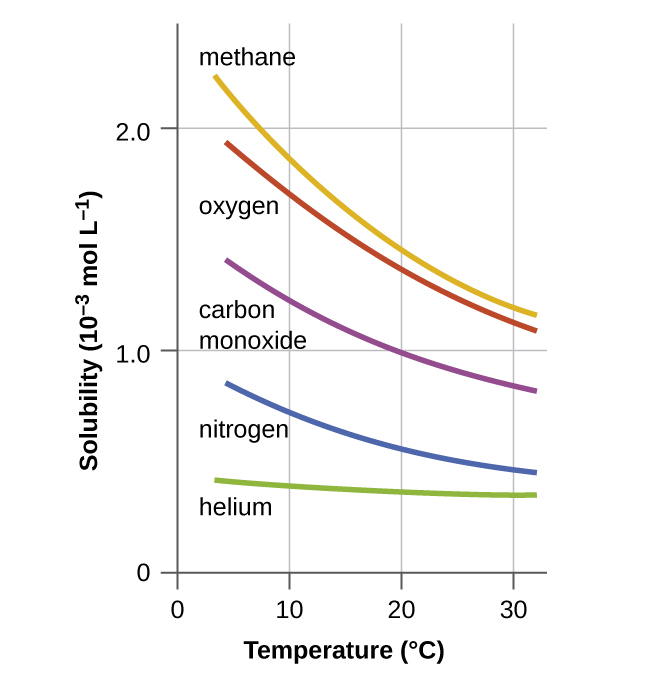
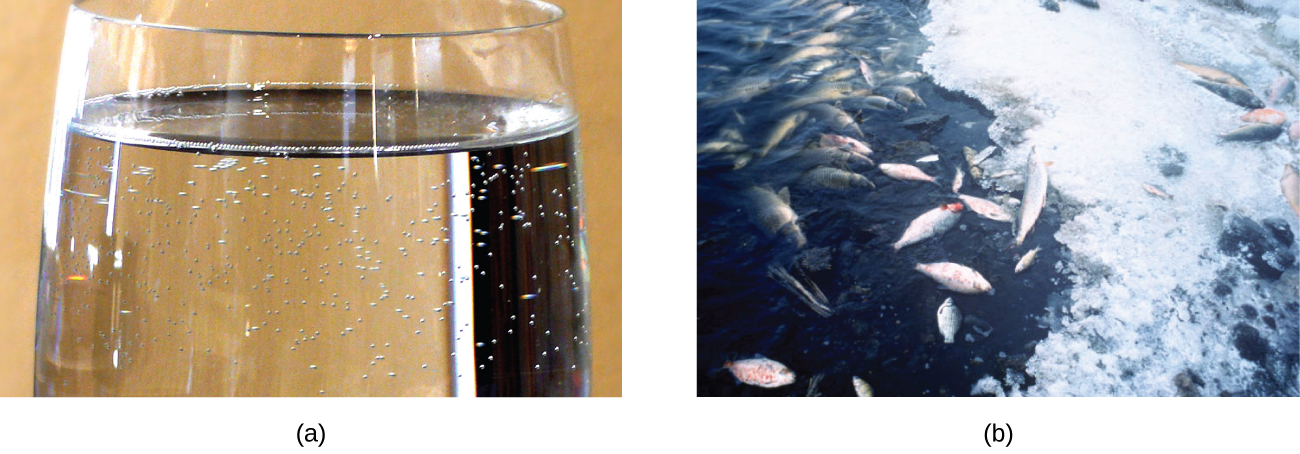
When the temperature of a river, lake, or stream is raised abnormally high, usually due to the discharge of hot h2o from some industrial process, the solubility of oxygen in the water is decreased. Decreased levels of dissolved oxygen may have serious consequences for the wellness of the water's ecosystems and, in astringent cases, tin result in large-scale fish kills (Figure 2).
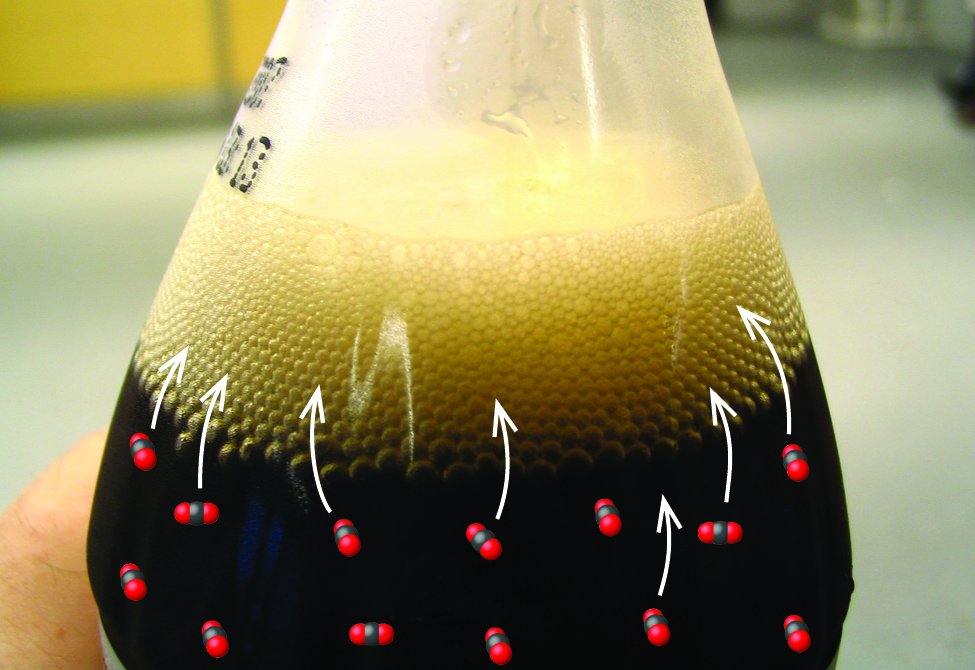
The solubility of a gaseous solute is also affected past the fractional pressure of solute in the gas to which the solution is exposed. Gas solubility increases every bit the force per unit area of the gas increases. Carbonated beverages provide a nice illustration of this relationship. The carbonation process involves exposing the beverage to a relatively loftier force per unit area of carbon dioxide gas and then sealing the drink container, thus saturating the drinkable with COii at this pressure. When the potable container is opened, a familiar hiss is heard as the carbon dioxide gas pressure is released, and some of the dissolved carbon dioxide is typically seen leaving solution in the grade of pocket-sized bubbles (Figure 3). At this bespeak, the beverage is supersaturated with carbon dioxide and, with time, the dissolved carbon dioxide concentration will decrease to its equilibrium value and the drink will become "flat."
For many gaseous solutes, the relation between solubility, C one thousand, and fractional pressure, P grand, is a proportional one:
[latex]C_{\text{g}} = kP_{\text{g}}[/latex]
where one thousand is a proportionality constant that depends on the identities of the gaseous solute and solvent, and on the solution temperature. This is a mathematical statement of Henry's police force: The quantity of an ideal gas that dissolves in a definite volume of liquid is directly proportional to the pressure level of the gas.
Case 1
Application of Henry'south Law
At 20 °C, the concentration of dissolved oxygen in water exposed to gaseous oxygen at a partial pressure level of 101.3 kPa (760 torr) is 1.38 × 10⁻³ mol 50−1. Utilize Henry's law to determine the solubility of oxygen when its partial pressure level is 20.7 kPa (155 torr), the approximate force per unit area of oxygen in earth's atmosphere.
Solution
According to Henry's police, for an ideal solution the solubility, C g, of a gas (1.38 × x−iii mol L−1, in this case) is directly proportional to the pressure level, P g, of the undissolved gas higher up the solution (101.3 kPa, or 760 torr, in this case). Considering we know both C grand and P g, we can rearrange this expression to solve for thou.
[latex]\begin{array}{r @{{}={}} l} C_{\text{g}} & kP_{\text{m}} \\[0.5em] k & \frac{C_{\text{g}}}{P_{\text{yard}}} \\[0.5em] & \frac{i.38\;\times\;ten^{-three}\;\text{mol\;L}^{-1}}{101.3\;\text{kPa}} \\[0.5em] & ane.36\;\times\; 10^{-five}\;\text{mol\;L}^{-one}\;\text{kPa}^{-i} \\[0.5em] & (1.82\;\times\;x^{-6}\;\text{mol\;L}^{-1}\;\text{torr}^{-1}) \end{array}[/latex]
Now we can apply yard to find the solubility at the lower pressure level.
[latex]C_{\text{g}} = kP_{\text{m}}[/latex]
[latex]ane.36\;\times\;ten^{-5}\;\text{mol\;L}^{-i}\;\text{kPa}^{-1}\;\times\;twenty.seven\;\text{kPa} \\[0.5em] (\text{or}\;1.82\;\times\;x^{-half-dozen}\;\text{mol\;L}^{-1}\;\text{torr}^{-1}\;\times\;155\;\text{torr}) \\[0.5em] = two.82\;\times\;ten^{-4}\;\text{mol\;L}^{-1}[/latex]
Annotation that various units may be used to limited the quantities involved in these sorts of computations. Any combination of units that yield to the constraints of dimensional analysis are adequate.
Check Your Learning
Exposing a 100.0 mL sample of water at 0 °C to an atmosphere containing a gaseous solute at xx.26 kPa (152 torr) resulted in the dissolution of 1.45 × x−3 grand of the solute. Use Henry's law to determine the solubility of this gaseous solute when its pressure is 101.three kPa (760 torr).
Answer:
7.25 × 10⁻³ in 100.0 mL or 0.0725 g/50
Decompression Sickness or "The Bends"
Decompression sickness (DCS), or "the bends," is an effect of the increased pressure of the air inhaled by scuba divers when swimming underwater at considerable depths. In improver to the pressure exerted by the temper, divers are subjected to boosted force per unit area due to the water to a higher place them, experiencing an increment of approximately 1 atm for each 10 m of depth. Therefore, the air inhaled by a diver while submerged contains gases at the corresponding college ambient pressure, and the concentrations of the gases dissolved in the diver'south blood are proportionally higher per Henry's law.
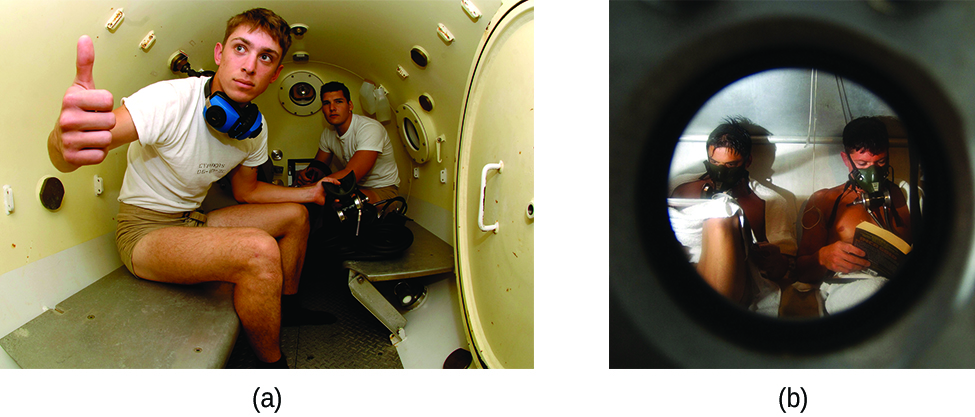
As the diver ascends to the surface of the water, the ambience pressure decreases and the dissolved gases becomes less soluble. If the rising is also rapid, the gases escaping from the diver's blood may form bubbles that can cause a diverseness of symptoms ranging from rashes and joint hurting to paralysis and death. To avoid DCS, divers must ascend from depths at relatively slow speeds (10 or 20 m/min) or otherwise brand several decompression stops, pausing for several minutes at given depths during the rise. When these preventive measures are unsuccessful, divers with DCS are often provided hyperbaric oxygen therapy in pressurized vessels called decompression (or recompression) chambers (Figure 4).
Deviations from Henry's police force are observed when a chemic reaction takes place between the gaseous solute and the solvent. Thus, for example, the solubility of ammonia in water does non increment as rapidly with increasing pressure equally predicted by the law because ammonia, being a base, reacts to some extent with water to form ammonium ions and hydroxide ions.

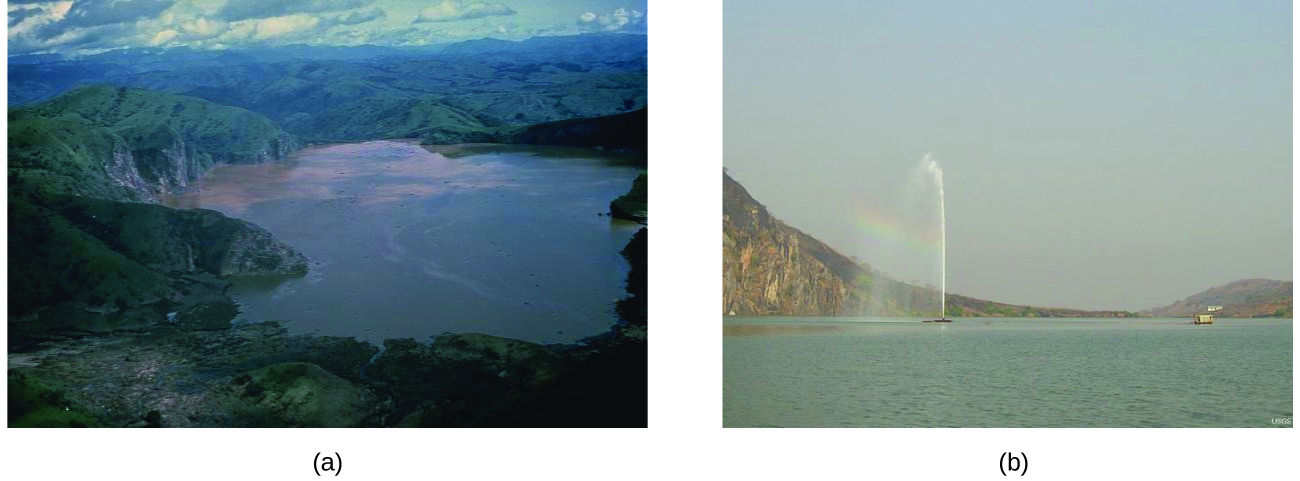
Gases can course supersaturated solutions. If a solution of a gas in a liquid is prepared either at low temperature or nether pressure (or both), and so every bit the solution warms or every bit the gas pressure is reduced, the solution may become supersaturated. In 1986, more than 1700 people in Cameroon were killed when a cloud of gas, virtually certainly carbon dioxide, bubbled from Lake Nyos (Figure 5), a deep lake in a volcanic crater. The h2o at the bottom of Lake Nyos is saturated with carbon dioxide by volcanic activity beneath the lake. It is believed that the lake underwent a turnover due to gradual heating from beneath the lake, and the warmer, less-dense water saturated with carbon dioxide reached the surface. Consequently, tremendous quantities of dissolved COii were released, and the colorless gas, which is denser than air, flowed downward the valley beneath the lake and suffocated humans and animals living in the valley.
Solutions of Liquids in Liquids
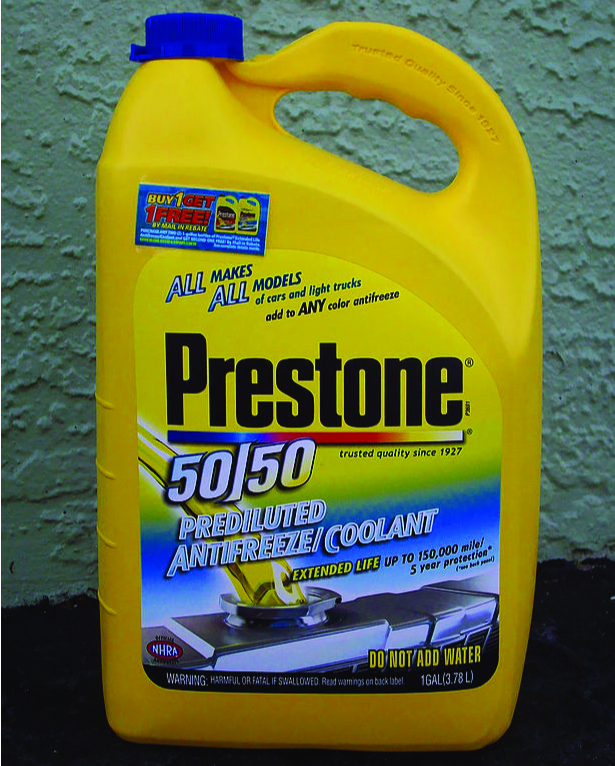
We know that some liquids mix with each other in all proportions; in other words, they have space mutual solubility and are said to exist miscible. Ethanol, sulfuric acid, and ethylene glycol (pop for utilize as antifreeze, pictured in Effigy 6) are examples of liquids that are completely miscible with water. Ii-cycle motor oil is miscible with gasoline.
Liquids that mix with h2o in all proportions are usually polar substances or substances that grade hydrogen bonds. For such liquids, the dipole-dipole attractions (or hydrogen bonding) of the solute molecules with the solvent molecules are at least as strong as those between molecules in the pure solute or in the pure solvent. Hence, the 2 kinds of molecules mix easily. Likewise, nonpolar liquids are miscible with each other considering in that location is no appreciable divergence in the strengths of solute-solute, solvent-solvent, and solute-solvent intermolecular attractions. The solubility of polar molecules in polar solvents and of nonpolar molecules in nonpolar solvents is, again, an illustration of the chemic axiom "like dissolves similar."
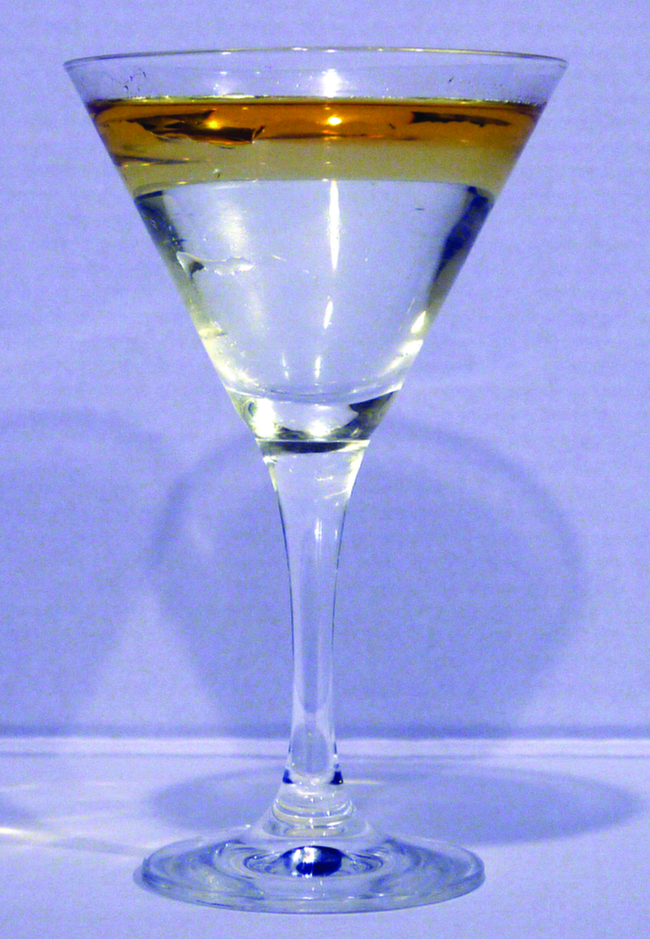
Two liquids that do not mix to an appreciable extent are called immiscible. Layers are formed when we pour immiscible liquids into the aforementioned container. Gasoline, oil (Effigy 7), benzene, carbon tetrachloride, some paints, and many other nonpolar liquids are immiscible with water. The attraction betwixt the molecules of such nonpolar liquids and polar h2o molecules is ineffectively weak. The just stiff attractions in such a mixture are betwixt the water molecules, and so they effectively squeeze out the molecules of the nonpolar liquid. The distinction betwixt immiscibility and miscibility is really 1 of degrees, then that miscible liquids are of infinite mutual solubility, while liquids said to be immiscible are of very low (though not zero) mutual solubility.
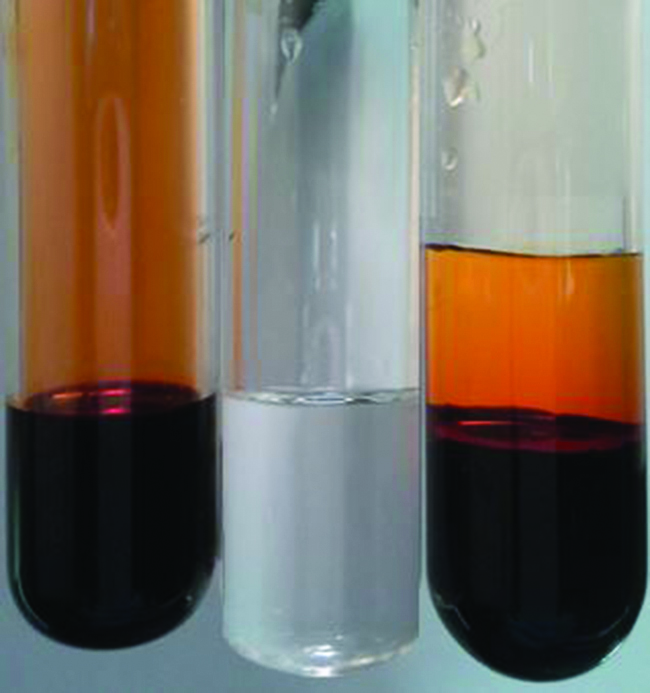
2 liquids, such as bromine and water, that are of moderate mutual solubility are said to be partially miscible. Two partially miscible liquids usually form two layers when mixed. In the case of the bromine and water mixture, the upper layer is water, saturated with bromine, and the lower layer is bromine saturated with water. Since bromine is nonpolar, and, thus, not very soluble in water, the h2o layer is but slightly discolored past the brilliant orange bromine dissolved in it. Since the solubility of h2o in bromine is very depression, at that place is no noticeable effect on the dark color of the bromine layer (Figure eight).
Solutions of Solids in Liquids
The dependence of solubility on temperature for a number of inorganic solids in water is shown by the solubility curves in Figure 9. Reviewing these data indicate a full general tendency of increasing solubility with temperature, although in that location are exceptions, every bit illustrated by the ionic compound cerium sulfate.
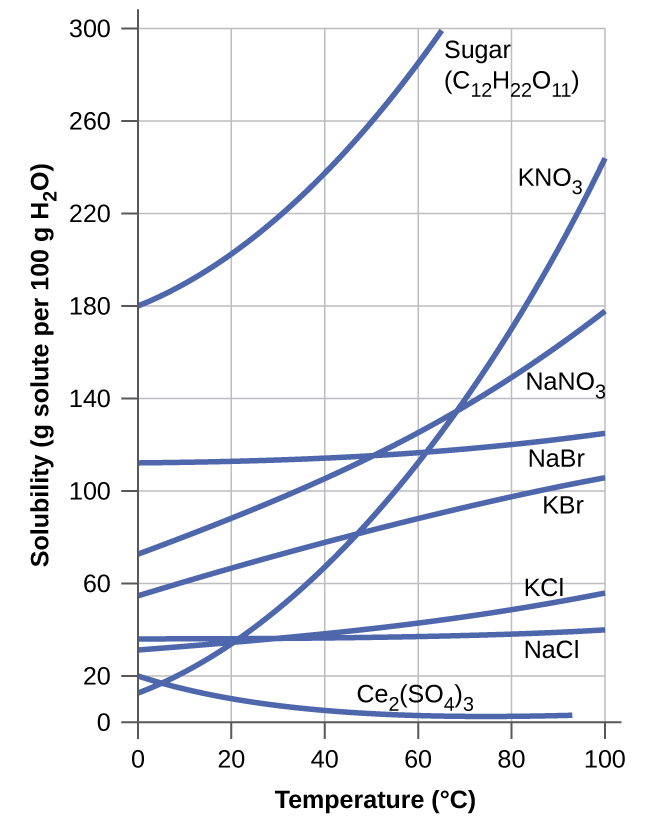
The temperature dependence of solubility can be exploited to prepare supersaturated solutions of certain compounds. A solution may be saturated with the compound at an elevated temperature (where the solute is more than soluble) and subsequently cooled to a lower temperature without precipitating the solute. The resultant solution contains solute at a concentration greater than its equilibrium solubility at the lower temperature (i.e., it is supersaturated) and is relatively stable. Atmospheric precipitation of the excess solute can exist initiated by adding a seed crystal (see the video in the Link to Learning earlier in this module) or by mechanically agitating the solution. Some hand warmers, such as the one pictured in Figure 10, take advantage of this beliefs.
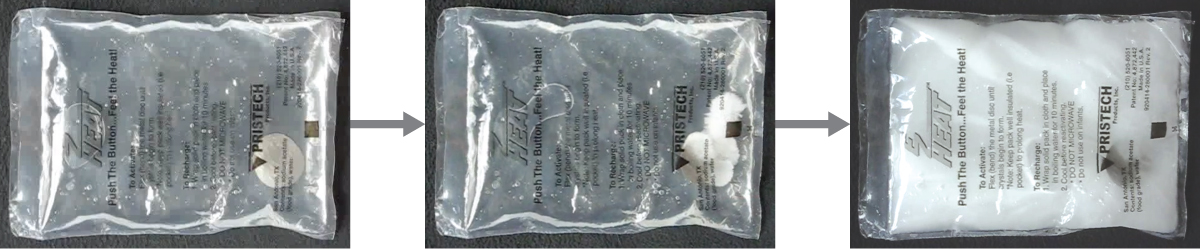
This video shows the crystallization process occurring in a mitt warmer.
Key Concepts and Summary
The extent to which one substance will dissolve in another is determined by several factors, including the types and relative strengths of intermolecular bonny forces that may exist between the substances' atoms, ions, or molecules. This tendency to dissolve is quantified equally substance's solubility, its maximum concentration in a solution at equilibrium under specified conditions. A saturated solution contains solute at a concentration equal to its solubility. A supersaturated solution is i in which a solute'southward concentration exceeds its solubility—a nonequilibrium (unstable) status that will result in solute precipitation when the solution is appropriately perturbed. Miscible liquids are soluble in all proportions, and immiscible liquids exhibit very depression common solubility. Solubilities for gaseous solutes decrease with increasing temperature, while those for nearly, but not all, solid solutes increase with temperature. The concentration of a gaseous solute in a solution is proportional to the partial pressure of the gas to which the solution is exposed, a relation known equally Henry's law.
Key Equations
- [latex]C_{\text{k}} = kP_{\text{m}}[/latex]
Chemistry Terminate of Chapter Exercises
- Suppose you lot are presented with a clear solution of sodium thiosulfate, Na2SiiO3. How could yous determine whether the solution is unsaturated, saturated, or supersaturated?
- Supersaturated solutions of most solids in h2o are prepared by cooling saturated solutions. Supersaturated solutions of most gases in water are prepared past heating saturated solutions. Explain the reasons for the divergence in the two procedures.
- Propose an explanation for the observations that ethanol, C2H5OH, is completely miscible with water and that ethanethiol, C2HvSH, is soluble only to the extent of 1.5 yard per 100 mL of h2o.
- Calculate the percent past mass of KBr in a saturated solution of KBr in water at 10 °C. See Figure 9 for useful data, and report the computed percentage to one significant digit.
- Which of the following gases is expected to exist near soluble in water? Explain your reasoning.
(a) CH4
(b) CCl4
(c) CHCliii
- At 0 °C and 1.00 atm, every bit much as 0.lxx g of O2 tin dissolve in i L of h2o. At 0 °C and 4.00 atm, how many grams of O2 dissolve in 1 50 of water?
- Refer to Figure iii.
(a) How did the concentration of dissolved CO2 in the drink alter when the bottle was opened?
(b) What acquired this change?
(c) Is the beverage unsaturated, saturated, or supersaturated with CO2?
- The Henry'south constabulary constant for CO2 is three.4 × ten−2 K/atm at 25 °C. What force per unit area of carbon dioxide is needed to maintain a CO2 concentration of 0.10 M in a tin can of lemon-lime soda?
- The Henry's police constant for O2 is 1.3 × 10−three Thou/atm at 25 °C. What mass of oxygen would be dissolved in a twoscore-L aquarium at 25 °C, assuming an atmospheric force per unit area of 1.00 atm, and that the partial pressure level of O2 is 0.21 atm?
- How many liters of HCl gas, measured at 30.0 °C and 745 torr, are required to prepare 1.25 Fifty of a 3.20-M solution of hydrochloric acid?
Glossary
- Henry's law
- law stating the proportional relationship between the concentration of dissolved gas in a solution and the partial pressure of the gas in contact with the solution
- immiscible
- of negligible mutual solubility; typically refers to liquid substances
- miscible
- mutually soluble in all proportions; typically refers to liquid substances
- partially miscible
- of moderate common solubility; typically refers to liquid substances
- saturated
- of concentration equal to solubility; containing the maximum concentration of solute possible for a given temperature and pressure
- solubility
- extent to which a solute may exist dissolved in water, or any solvent
- supersaturated
- of concentration that exceeds solubility; a nonequilibrium state
- unsaturated
- of concentration less than solubility
Solutions
Answers to Chemical science Finish of Chapter Exercises
ii. The solubility of solids usually decreases upon cooling a solution, while the solubility of gases usually decreases upon heating.
iv. 40%
6. 2.80 g
8. 2.9 atm
10. 102 50 HCl
Source: https://opentextbc.ca/chemistry/chapter/11-3-solubility/
0 Response to "Which Type of Sparingly Soluble Solid Can Generally Be Dissolved With Strong Acid?"
Post a Comment